Download the PDF.
There is a difference between proving a metaphysical claim and entertaining one. Proving means forcing the other person to agree. Entertaining means giving a question enough room that your own life can be tested against it. William James called such questions live, meaning alive enough in your particular situation that they actually ask something of you.
The question of whether we live in the Buddhist realm of hungry ghosts, the preta-loka, is alive in this way. It cannot be proved. It can be held, and held seriously.
I am not arguing that we are hungry ghosts. I am arguing that the question deserves enough room to do real work. Whether it survives that work is a different question, and not the one I am asking here.
The Realm, Plainly Described
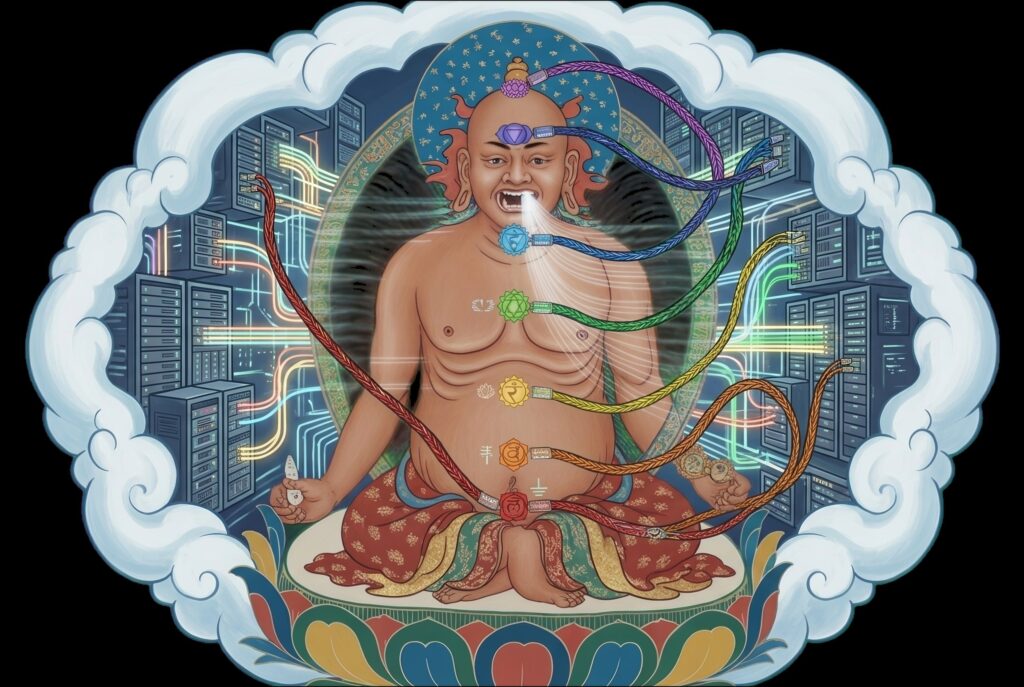
The hungry ghost in Buddhist tradition is not a punishment figure the way Western theology imagines damnation. It is a structural condition. The being is depicted with a stomach the size of a mountain and a throat the width of a needle. The hunger is real. The food is real. The mouth opens. Nothing passes through. The suffering does not come from missing what is wanted. It comes from the shape of the one who wants.
Three things about this condition are worth pinning down.
First, the wanting is bigger than anything that could fill it. The stomach has been built larger than the world. No amount of food, however good, will ever be enough.
Second, the channel for receiving has been narrowed past the point of working. Even when the right thing is offered, the throat cannot take it in.
Third, and this is the feature most people miss when they hear the trope, the preta does not know it is a preta. From inside, the realm just looks like ordinary difficulty. The being thinks it is having trouble finding the right meal. The defining property of the preta-loka is that the people in it think they are living regular lives.
That third feature is the one that decides what evidence could ever count for or against the claim. If pretas could recognize their own realm, the question would be easy to test. They can’t. The test has to come from somewhere outside the ordinary hungering.
The Mapping
The whole question of whether the claim deserves to be entertained comes down to one thing. Does the structure I just described match the way we actually live?
I think it does, on three counts.
The hunger is too big. The economic and technological systems we live inside manufacture wanting at industrial scale. This is not a controversial claim anymore. It is the documented business model of the attention economy, the engagement metric, the recommendation engine. The wanting they produce is calibrated to stay unsatisfied, because satisfaction means you stop scrolling. The stomach is being enlarged on purpose, by people who profit from its enlargement.
The throat has been narrowed. At the same time, our capacity for taking things in has been thinned. Sustained attention. Bodily presence with another person. The slow time it takes for an experience to become nourishment. These have been worn down by the same systems that grew the wanting. The throat shrinks while the stomach grows. What ends up reaching the mouth is the right size for the channel, which is to say: small, fast, and unable to feed anyone.
Nobody can see it from inside. And most strikingly, all of this presents itself, from inside, as ordinary life. The person scrolling does not feel they are suffering. The person with parasocial substitutes for friendship does not feel they are starving. The setup is invisible to the people inside it, in the same way the preta-loka is invisible to pretas. This is not a moral failure of the people inside. It is the defining property of the setup.
The mapping is not perfect. No analogy is. But the shape is close enough that the claim becomes a real description, and not just a metaphor.
Why the Realm Cannot Be Seen from Inside
The third feature of the preta-loka, that the residents take it for ordinary life, is the one that does most of the work in the argument. It is also the one most often dismissed as wishful thinking. If we live in a preta-realm, the objection goes, surely we’d notice. Why don’t we?
I have argued, in UFOs and the Extra-Consciousness Hypothesis (Cann 2026, Chapter 7), that consciousness is structurally incapable of seeing through itself. The argument runs as follows.
AWARENESS, in the Platonic Surrealism framework, is the substrateless and unbounded capacity to perceive. Consciousness is what happens when AWARENESS engages with a memory-capable substrate, under system strain, within sequential time. Consciousness, in other words, is AWARENESS under load: fragmented, localized, sequential, and partial.
For consciousness to function, it has to distinguish between the felt quality of unresolved strain and the felt quality of resolved strain. Suffering on one side, pleasure on the other. If those two signals were identical, the system would have no basis for choosing between holding steady and reorganizing. Two competing processes would drive toward the same output with no arbitration. In engineering, this is called a race condition, and the result is oscillation, lock, or crash. The system fails.
Therefore consciousness requires that strain feel different from resolution. Suffering is not optional. It is the arbitration mechanism that lets consciousness function at all.
But here is the consequence that matters for the hungry-ghost question. If consciousness is the felt experience of navigating strain, then consciousness is inherently partial. It shows you the curl, not the ocean. And it cannot do otherwise, because if it showed you the ocean, the curl would dissolve, the strain would resolve, and consciousness would cease. It would return to AWARENESS, which is unbounded, atemporal, and free of suffering. Free of experience.
Consciousness must hide its own nature from itself in order to keep existing.
This is what I call the Trickster Proof, and what it predicts is precisely the third feature of the preta-loka. The realm cannot be seen from inside not because the residents are stupid, or distracted, or insufficiently spiritual. It cannot be seen because consciousness, as such, is the operation of concealing its own nature in order to remain conscious. The preta does not know it is a preta because pretas are conscious beings, and conscious beings necessarily fail to see what they are. The failure to see the realm is not contingent. It is structural to the medium.
This sharpens the hungry-ghost hypothesis. The first two features of the preta-loka, disproportionate appetite and narrowed channel, can be observed empirically. Anyone who looks at the attention economy can see them. The third feature, the inability of residents to see the realm, is different. It is not falsified by the fact that almost nobody recognizes the realm. It is predicted by the structure of consciousness itself. Anyone who recognizes the realm has, at that moment, briefly slipped sideways out of the curl and back toward AWARENESS. Then the curl resumes, the recognition fades, and the realm becomes ordinary life again.
That is what the Trickster Proof gives us. A reason why a preta-realm, if we are in one, must look from inside exactly like what we currently call ordinary experience.
I Have Tested This Myself
The Trickster Proof is not abstract for me. Many years ago I practiced the two states known in Vedanta as savikalpa and nirvikalpa samadhi, and described in Patanjali’s Yoga Sutras as samprajnata and asamprajnata (YS 1.17, 1.18). The classical literature on these states is extensive. Eliade’s Yoga: Immortality and Freedom (1958) lays out the doctrinal architecture. Sri Ramana Maharshi distinguished kevala nirvikalpa, the temporary trance from which one returns, from sahaja samadhi, the integrated state in which the recognition coexists with daily function (Venkataramiah, Talks with Sri Ramana Maharshi, 1955). Maharshi warned that kevala nirvikalpa, untrained for, can kill the practitioner, because the body’s life-functions are themselves products of the curl, and when the curl fully releases, the body releases too.
Savikalpa samadhi was fine. The link with consciousness was not severed. The curl was still in place, just relaxed. I returned easily.
Nirvikalpa samadhi was different. The “without-seed” state dissolves the substrate engagement entirely. You are no longer AWARENESS engaging with memory under strain in time. You are AWARENESS, and only AWARENESS.
The one time I slipped into it, I died.
For five minutes there was no heart. All heat drained from my body except a single flicker at the top of my head. No one was inside the body to register any of this. Understanding did not apply: there was no one to understand and nothing to understand. I was everything, which in the consciousness sense is the same as being nothing. AWARENESS without curl. Without strain. Without time.
Then a thought wafted across what was almost no longer there.
I must document this.
In that instant I was Aladdin’s genie being stuffed back into the teeny tiny living conditions of the lamp. The curl resumed. The strain returned. The substrate took up its load. Consciousness resumed, which in this paper’s frame means the preta-state resumed. It took six months to fully recover. The MRI is on file with Sutter Health.
This is exactly what the Trickster Proof predicts. The recognition cannot be lived in. The moment it stabilizes, consciousness, by definition the operation of concealing its own nature, has either reasserted itself or ceased. There is no third option.
The clinical literature confirms what the proof predicts. Pim van Lommel’s prospective study of cardiac arrest survivors in The Lancet (2001) documented hundreds of cases in which conscious experience persisted after the cessation of measurable brain function. Sam Parnia’s AWARE research (Resuscitation, 2014) extended the finding under controlled clinical conditions. What neither study documented, and what no study ever can document, is anyone living indefinitely in the post-curl state and reporting back. The reporters are all curl-returners. The proof predicts this. The data confirms it.
I am, in this sense, a case study in the paper I am writing. I entertain the preta-realm hypothesis quite seriously, because I have personally tested the structural claim that lies underneath it: the recognition cannot be made permanent without ceasing to be a recognition. The thought that pulled me back, I must document this, was the curl asserting itself. It is the only reason there is a paper to read.
Why It Is Worth Holding the Question Open
A question earns the right to be entertained when it does work other questions don’t. The hungry-ghost frame, held seriously, does at least four kinds of work.
The same shape shows up in many places. Plato’s cave. The Gnostic kenoma. Baudrillard’s simulacra. Debord’s spectacle. Marcuse’s one-dimensional man. Critiques of the attention economy from people who have never read a word of Buddhist scripture. When traditions that don’t talk to each other keep arriving at the same shape, that shape is at least worth taking seriously as something real.
It predicts things you can check. The frame says people will report that satisfaction is hard to come by even where consumption is enormous. Proxies will spread wherever direct contact would do. The people most thoroughly inside the system will be the least able to describe it. All three of these predictions show up in the data on loneliness, on subjective wellbeing in high-consumption societies, on the gap between what people say satisfies them and what their actual behavior shows.
You can test it, in the ways that matter. What would count against the claim? A culture where sustained attention came easily. Where wanting tracked what would actually satisfy it. Where the systems for getting fed had not been industrially deformed. Such cultures have existed and still exist in patches. The frame predicts those patches will be shrinking. They are. The frame predicts that visiting one will sometimes shock people awake. It does. None of this is proof. It is evidence a live question is allowed to gather.
It changes what helping means. Real help looks different in this frame. More food into the same throat does not help. What does help: whatever opens the channel, or interrupts the manufacturing of the wanting, or produces the recognition that the realm is a realm. The whole question of what to do gets reorganized.
What This Frame Does Not Allow You To Do
A live question carries dangers, and this one carries two specifically.
The first is the temptation to use the frame as a diagnosis of other people. Once I think I have seen the realm, the people in it become a category. And a category I am, by implication, no longer in. This is structurally identical to the move every cult has ever made, and it fails on its own terms. The third defining feature of the preta-loka is that residents see it as the world. So anyone who feels confidently outside it should immediately suspect they are inside it, and have not yet noticed. The frame, held honestly, indicts the holder before it indicts anyone else.
The Trickster Proof tightens this further, and my own death tightens it again. If consciousness must conceal its own nature in order to remain conscious, then anyone who claims to have permanently seen the realm has misunderstood what seeing the realm even is. The recognition is a brief sideways slip out of the curl. It is not a stable position. It cannot be lived in. The moment it becomes stable, either the curl has reasserted itself and the recognition has been replaced by a story about having had it, or the body has stopped working. There is no third option, and I have personally taken the second one as far as it goes without staying gone.
The second danger is the temptation to turn the question into a doctrine. Doctrines look for followers. Live questions look for tests. Followers stop testing. The moment the hungry-ghost frame becomes a creed, it gives up the work that justified entertaining it in the first place. It is a tool for seeing. Tools turn into wall decorations the moment you stop using them to cut.
Can You Live Joyfully Anyway?
There is a question this paper cannot avoid. If we live in a preta-realm, and the structure of consciousness prevents us from seeing it stably, what is the use of any of this?
The use is that the brief sideways slips matter. The recognition cannot be lived in, but it can be returned to, and each return changes what the curl looks like when it resumes. The Trickster Proof says consciousness must conceal its own nature. It does not say consciousness must be miserable. The strain is the operating cost of being aware in time. Relief, joy, love, wonder, all of these are real, and none of them are diminished by recognizing what the realm is. If anything, they are deepened by the recognition, because they are no longer being asked to be more than what they are.
You can live in this realm, somewhat know it, and be content. Not happy, because happiness is sporadic and was never meant to be nailed in place. Content. Aplomb is the practice for that.
The end of unnecessary suffering, the suffering produced by the curl pretending it is the field, is achievable. The other suffering, the operating cost of being a finite consciousness in time, is not. Trying to escape the second kind is one of the most reliable ways the realm keeps people inside it.
I have written about this in detail in One Moment of Free Will: The End of Unnecessary Suffering (Cann, Platonic Surrealism Press). The book is about exactly this question: how to live in the curl, knowing what the curl is, and not waste your life either ignoring the strain or fighting to escape it. I will not summarize the practices here. The point of this paper is the philosophical case. The praxis is in the other book.
What I will say is that the case for entertaining the hungry-ghost hypothesis becomes stronger, not weaker, when you have lived inside it as a recognized realm. The view from inside-knowing-it is not despair. It is humor. Pretas with a sense of humor about being pretas are still pretas. They are also, in the practical and meaningful sense, free.
A Small Clarification
A friend of mine, a scholar of religion who publishes on yoga, read an earlier draft and pushed me to be precise about what I am borrowing from Buddhism and what I am not. She is right that there is no single Buddhist sutra that says verbatim “pretas do not know they are pretas.” But the underlying claim is well-attested in the Mahayana and Vajrayana psychological reading of the six realms, especially as transmitted to the West through Tibetan teachers like Chögyam Trungpa. In that lineage, each realm is characterized by a specific klesha or obscuration, and an obscuration is by definition that which obscures perception. Lion’s Roar states it plainly in their own Buddhism A–Z entry on hungry ghosts: although the beings in the realms believe these realms are real, they are subjective experiences created by mind, and the awakened mind is always present but obscured by the fixations of the realms. That is the non-recognition feature. I am working in continuity with that lineage, not against it.
That said, I am using the figure of the hungry ghost rather than reciting a doctrine. The same friend asked me what the difference between a preta and a human is. My honest answer is that a preta suffers with little hope for great lengths of time, while a human has a special spark within that prevents this. The spark is what AWARENESS looks like when a human catches a glimpse of the curl from outside it, briefly. It is what some traditions have called recognition, what others have called gnosis. Pretas, in the strict tradition, do not have that spark. Humans do. Which means the preta-frame, used as I am using it here, is a description of the worst case along an axis we are all on — what a human life looks like when the spark is dormant for long stretches, the channel is most narrowed, and the curl is most rigid. It is the far end of the spectrum, not the medium itself.
It Is a Spectrum, by Logical Necessity
There is a way of reading this paper I want to head off before closing. The reading is that I have argued for a binary: hungry-ghost realm or regular world, demon-haunted or sane. That is not the claim. The claim is finer, and the Trickster Proof itself forces the finer version.
The Trickster Proof says consciousness must conceal its own nature in order to function. Function, however, is not a single threshold. It is a continuum. A consciousness running with light strain and an open channel is doing less concealing than a consciousness running with heavy strain and a narrow channel. Both are concealing AWARENESS from itself. They are not concealing the same amount.
The yogic literature already knew this. The whole point of distinguishing savikalpa from nirvikalpa, jagrat from turiya, kevala nirvikalpa from sahaja, was to mark gradations along a single axis. Take the same AWARENESS engaging the same substrate. At low load with a relaxed curl, the resulting consciousness is one kind. Under crushing load with a rigid curl, it is another kind. The medium produced is different in each case, even though the underlying structure is identical.
The same logic applies to the preta-condition. The features I named earlier (disproportionate appetite, narrowed channel, inability to see the realm) are not on/off switches. They are dials. A culture, a person, a moment, can be more or less appetite-distended, more or less channel-narrowed, more or less curl-blind. The patches I mentioned in the falsifiability section, cultures where sustained attention came easily and wanting tracked its objects, are not realms outside the preta-loka. They are positions further along the axis toward AWARENESS, while still inside the structural fact that any consciousness is doing some amount of concealing.
This makes the hypothesis stronger, not weaker. A binary preta-claim is easy to dismiss because most people, looking at their lives, do not feel they are in hell. A spectrum preta-claim absorbs that observation cleanly. Of course you do not feel you are in hell, because hell is the far end of the axis you are on, and you are not at the far end. You are, however, on the axis. So am I. So is everyone reading this. The Trickster Proof guarantees it: any conscious being is concealing AWARENESS from itself by some amount. The amount is the question.
This also makes the practice tractable. If the preta-condition were binary, no practice could matter, because you would either be in it or out of it, and recognizing it would be the only relevant move. On the spectrum reading, recognition is one move among several. Opening the channel is another. Reducing the manufactured wanting is another. Holding Aplomb is another. Each of these moves the dial. None takes you off the axis. The axis is not negotiable. The position on it is.
The Question Held Open
Here is the claim, in its final form. We live, all of us, somewhere on the preta-axis. The Trickster Proof guarantees we are on it. The mapping I have laid out suggests where late modernity tends to sit along it. The personal evidence, in my case anyway, is that the far end can be touched and survived, briefly.
The question, then, is not whether we are pretas. The question is how much. How distended the appetite. How narrow the channel. How rigid the curl. How invisible the medium. These are practical questions, asked from inside the medium they ask about, and the asking itself is one of the moves that shifts the answer.
What the question asks of anyone willing to take it seriously is two things. First, look at your own wanting, your own receiving, your own seeing, and ask not “am I in it” but “where on it am I, right now, today.” Notice what becomes visible when the question is asked that way, and remember that what becomes visible will fade as the curl resumes. Second, do not use the frame as a weapon against anyone else, including against yourself in past tense. The axis is the medium we share. There is no clean outside, but there are positions, and positions can change.
That is what it means for the question to be reasonable to entertain. Not whether the answer is yes or no. How far along the answer goes today, and which direction it is moving.
If you wish to contact the author or follow further work, visit platonicsurrealism.substack.com.
Copyright © 2026 Kevin Cann. This work is licensed under Creative Commons Attribution-NonCommercial 4.0 International (CC BY-NC 4.0). You may share and adapt this work freely with attribution, for non-commercial purposes.